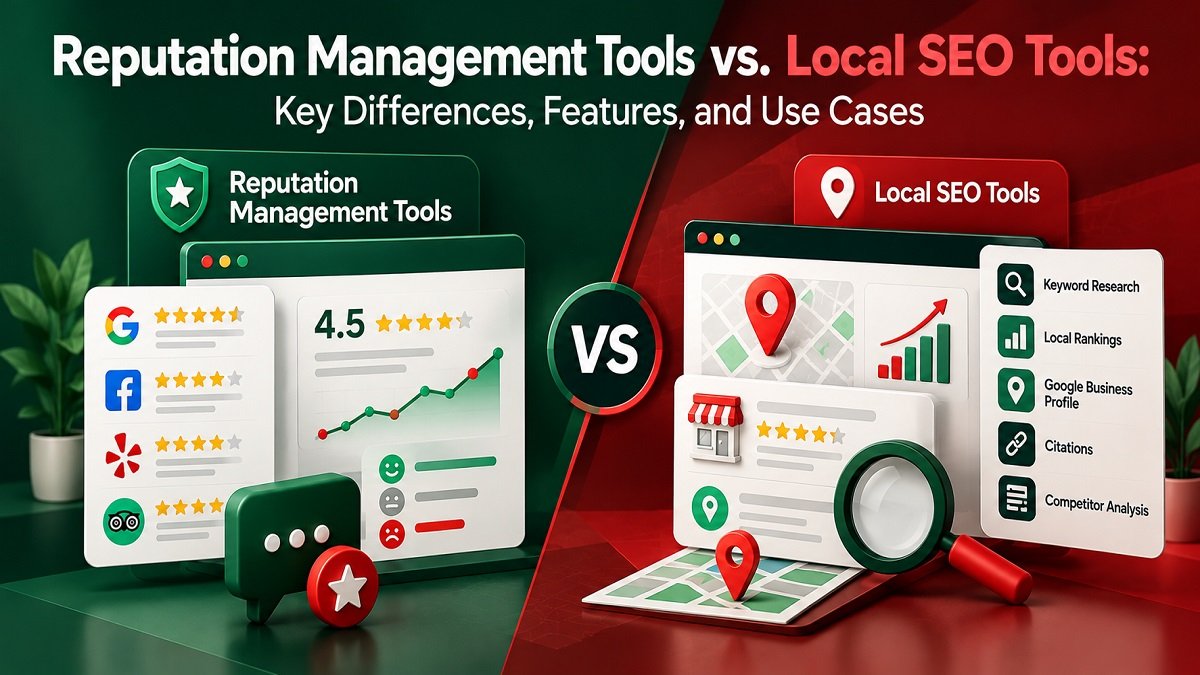
Reputation Management Tools vs. Local SEO Tools: Key Differences
Reputation Management Tools help businesses manage reviews, build customer trust, and support local SEO visibility through effective review monitoring and response strategies.
Choosing the right marketing software can make a significant difference in how a local business attracts customers, manages its online presence, and competes in search results. However, many businesses struggle to understand the difference between reputation management platforms and local search optimization software. Although these solutions sometimes offer overlapping features, they serve different purposes.
Reputation Management Tools help businesses monitor customer feedback, manage online reviews, track brand sentiment, and improve how people perceive their services. Local SEO tools, by comparison, focus on improving visibility in location-based searches, maintaining business listing accuracy, tracking local rankings, and identifying opportunities to attract nearby customers.
Understanding these differences is important before investing in either category. A restaurant may need better review management, while a home services company may prioritize local rankings and business listings. A multi-location brand might need both.
This guide compares Reputation Management Tools with local SEO platforms, explains their essential features, explores practical integrations, and shows how businesses can evaluate each option according to their marketing goals.
What Are Reputation Management Tools?
Reputation Management Tools are software solutions designed to help businesses monitor, organize, and improve their online reputation. They typically collect customer reviews from supported platforms, notify teams about new feedback, and provide workflows for responding to reviews efficiently.
These platforms are especially useful for businesses that depend on customer trust. Restaurants, dental practices, hotels, home service providers, and retail stores can all benefit from understanding what customers say about their experiences.
Common capabilities include:
-
Review monitoring: Track new reviews across supported websites and platforms.
-
Response management: Organize and publish responses from a centralized dashboard.
-
Sentiment analysis: Identify recurring positive and negative themes in customer feedback.
-
Review generation: Request feedback from customers through supported email or text workflows.
-
Reporting: Measure review volume, average ratings, response activity, and reputation trends.
-
Team collaboration: Assign feedback to employees and establish response responsibilities.
Reputation Management Tools help businesses understand customer perceptions and identify service improvements. For example, a plumbing company might discover that customers frequently praise its technicians but complain about scheduling delays. Management can use this information to improve operations rather than treating every negative review as a marketing problem.
These tools can also support local search performance indirectly. A strong review profile may help customers feel more confident about contacting a business, although no software can guarantee higher Google rankings simply by increasing review volume.
What Are Local SEO Tools?
Local SEO tools help businesses improve their visibility when people search for products or services in a particular geographic area. Their primary purpose is to support discovery through search engines, business listings, location-specific content, and local competitive analysis.
Unlike reputation-focused software, local search platforms often examine a broader set of ranking and visibility factors.
Typical features include:
-
Local rank tracking: Monitor rankings for relevant search terms across geographic areas.
-
Business listing management: Maintain consistent names, addresses, phone numbers, and other business details.
-
Google Business Profile support: Monitor supported profile information and performance indicators.
-
Citation auditing: Identify inconsistent or duplicate business listings.
-
Competitor analysis: Compare search visibility and listing coverage with competing businesses.
-
Keyword research: Discover location-specific search terms and customer demand.
-
Website audits: Identify technical and on-page SEO issues affecting organic search visibility.
-
Local reporting: Track changes in rankings, website traffic, and other available performance metrics.
For example, a roofing company serving several cities may use local SEO software to identify which service areas generate search impressions and where competitors have stronger visibility.
The company can then improve relevant service pages, correct listing inconsistencies, and refine its local marketing strategy.
While some local SEO platforms include review monitoring, their broader objective is to improve discoverability rather than manage every aspect of customer feedback.
Reputation Management Tools vs. Local SEO Tools: Key Differences
The most important distinction is the business outcome each category is designed to support. Reputation software focuses on customer feedback and public perception, while local SEO software focuses on search visibility and location-based discovery.
| Evaluation area | Reputation management software | Local SEO software |
|---|---|---|
| Primary objective | Monitor and improve online reputation | Improve local search visibility |
| Core data | Reviews, ratings, sentiment, responses | Rankings, listings, keywords, search visibility |
| Main workflow | Monitor feedback and manage responses | Audit, optimize, and track local search presence |
| Typical users | Customer service, marketing, operations | SEO specialists, marketers, agencies |
| Competitive analysis | Review quality and reputation trends | Local rankings, listings, and keyword visibility |
| Common reporting | Review volume, ratings, response activity | Rankings, listing accuracy, organic traffic |
| Customer impact | Builds trust and helps identify service issues | Helps customers discover relevant businesses |
| Best-fit use case | Businesses with substantial review activity | Businesses targeting local search demand |
The distinction is not absolute. Some platforms combine review management, listing updates, rank tracking, and analytics in one interface. Therefore, buyers should evaluate the actual features included in each subscription rather than relying exclusively on product categories.
Feature Comparison: What Should You Look For?
1. Review Monitoring and Response Management
Review monitoring is one of the strongest reasons to invest in Reputation Management Tools. Businesses with multiple locations may receive feedback across several platforms, making manual monitoring difficult.
A centralized dashboard can help teams identify new reviews, prioritize urgent complaints, assign responses, and maintain consistent communication. Some systems also offer automated notifications and suggested replies.
However, automation should not replace judgment. A customer reporting a billing dispute or safety concern deserves a thoughtful response rather than a generic template.
When evaluating this feature, check which review platforms are supported, whether responses can be published directly, and how user permissions work.
2. Local Ranking and Keyword Tracking
Local SEO software is particularly valuable when a business needs to understand where it appears for searches such as "emergency plumber near me" or "family dentist in Austin."
Rank-tracking capabilities vary considerably. Some platforms provide location-specific grid reports, while others focus on broader geographic rankings or keyword positions.
Businesses should look for reporting that matches their actual service areas. A company operating across multiple neighborhoods needs more detailed geographic insights than a single-location business serving a small town.
The most useful reports connect search visibility to actionable decisions, such as improving a service page or investigating a competitor's stronger presence in a particular area.
3. Listings and Business Information Management
Accurate business information helps customers find and contact a business. Incorrect phone numbers, outdated opening hours, duplicate listings, or inconsistent addresses can create unnecessary friction.
Local SEO platforms may offer listing distribution, duplicate detection, and monitoring for supported directories. Reputation-focused platforms may provide similar features as part of a broader customer experience suite.
Compare the number of supported directories, update frequency, location limits, and procedures for handling duplicate listings.
Do not assume that every platform automatically updates every directory. Coverage and permissions vary, and certain changes may require verification or manual intervention.
4. Analytics and Performance Reporting
Reputation Management Tools commonly report on ratings, review volume, response rates, and sentiment trends. These measurements help businesses evaluate customer feedback and identify recurring service problems.
Local SEO platforms generally emphasize ranking changes, keyword coverage, listing performance, and organic visibility.
The best reporting system connects these measurements with business outcomes. For instance, a company might compare customer feedback trends with qualified leads, calls, appointment requests, or completed sales.
Avoid treating a single metric as proof of success. A higher average rating does not automatically mean more revenue, and a ranking improvement does not guarantee more conversions.
Integrations: How the Two Categories Work Together
Integrations can determine whether marketing software becomes a useful part of daily operations or another disconnected dashboard.
Reputation Management Tools may connect with customer relationship management (CRM) systems, email marketing platforms, appointment software, point-of-sale systems, and customer support applications. These integrations can help businesses request reviews after completed transactions, route complaints to the right team, and connect feedback with customer records.
Local SEO tools may integrate with Google Business Profile, Google Analytics, Google Search Console, website content management systems, call tracking services, and reporting platforms. Availability depends on the provider, subscription, permissions, and supported data sources.
Before purchasing software, consider these integration requirements:
-
CRM connectivity: Can customer feedback or marketing activity be connected to existing customer records?
-
Review request workflows: Can the system send review invitations after legitimate customer interactions?
-
Analytics access: Can local search performance be compared with website traffic and conversions?
-
Multi-location support: Can users manage separate locations without mixing reporting data?
-
API access: Are custom integrations possible when standard connectors are insufficient?
-
Data permissions: Does the platform provide appropriate access controls and privacy safeguards?
For example, a multi-location dental group might connect appointment software with a review platform to request feedback after completed visits. Its SEO team could then use a separate local search platform to evaluate location-specific visibility.
This approach creates complementary workflows without assuming that one tool can handle every marketing task.
Practical SEO Applications: When Should You Use Each Tool?
Use Reputation Management Tools When Customer Trust Is the Priority
A business should prioritize reputation software when it struggles to monitor reviews, respond consistently, or identify repeated customer complaints.
Consider a restaurant group with eight locations. Managers may receive feedback about food quality, wait times, cleanliness, and staff communication across different review platforms.
A reputation platform can organize these reviews, highlight recurring themes, and help management assign follow-up actions. The business can then use customer feedback to improve service quality and strengthen trust.
These tools are also useful for agencies managing review workflows for multiple clients, provided the platform offers appropriate account separation and permissions.
Use Local SEO Tools When Search Visibility Is the Priority
A business should prioritize local SEO software when customers cannot easily discover its services through location-based searches.
Imagine a landscaping company serving several suburbs around Dallas. Its website may attract visitors from the main city while performing poorly in surrounding service areas.
Local SEO tools can help identify ranking gaps, inconsistent listings, relevant keywords, and competitor opportunities. The company can use these findings to improve service-area pages, strengthen business information, and monitor search visibility.
The objective is to make the business easier to discover when potential customers search for relevant services.
Use Both When Reputation and Visibility Need Improvement
Many businesses eventually benefit from combining the two categories.
For example, a home remodeling company may have accurate listings and strong local rankings but receive inconsistent customer reviews. Its SEO software helps identify visibility opportunities, while reputation software helps organize feedback and improve response processes.
The two workflows support different stages of the customer journey. Local SEO helps potential customers discover the company, while a credible reputation can influence whether they feel comfortable requesting an estimate.
For the best results, connect these activities to qualified leads and customer acquisition rather than treating rankings or ratings as isolated goals.
How to Evaluate and Choose the Right Platform
Selecting software should begin with a clearly defined business problem, not a long feature checklist.
Step 1: Define Your Primary Goal
Decide whether the immediate priority is review management, local visibility, listing accuracy, competitive research, or a combination of these objectives.
A focused goal makes it easier to compare platforms and avoid paying for capabilities the team will not use.
Step 2: Audit Your Current Workflow
Identify how reviews are monitored, how listings are updated, how rankings are measured, and how reports reach decision-makers.
If the main problem is missed customer feedback, reputation software may offer the greatest immediate value. If the business lacks reliable local ranking data, a search-focused platform may be more appropriate.
Step 3: Compare Essential Features
Evaluate Reputation Management Tools based on review coverage, response workflows, reporting, integrations, and multi-location capabilities.
For local SEO platforms, examine geographic rank tracking, listing management, keyword research, competitor analysis, and reporting flexibility.
Ask vendors to demonstrate the exact workflows your team needs instead of relying on feature names alone.
Step 4: Assess Total Cost and Scalability
Review subscription fees, per-location charges, user limits, onboarding costs, API access, and contract requirements.
A low starting price may become expensive as the business expands. Conversely, a large enterprise platform may be unnecessary for a single-location business.
Choose a solution that meets current requirements while leaving room for realistic growth.
Step 5: Test Reporting and Usability
Use a trial or demonstration to assess how easily employees can complete everyday tasks.
Check whether reports are understandable, whether alerts are useful, and whether managers can identify clear next steps without extensive manual analysis.
The best platform is not necessarily the one with the most features. It is the one that helps the team make better decisions consistently.
Common Mistakes to Avoid
Businesses can waste money on marketing software when they focus on features instead of operational needs.
One common mistake is assuming that Reputation Management Tools automatically improve search rankings. These platforms can support customer trust and review management, but ranking outcomes depend on many factors.
Another mistake is buying separate platforms with overlapping functionality. Before subscribing, compare existing capabilities and determine whether a combined platform can meet the requirements without sacrificing important features.
Businesses should also avoid generating misleading reviews, offering prohibited incentives, or using review-gating practices that selectively solicit positive feedback. Review collection should follow applicable platform policies and consumer protection requirements.
Finally, do not measure success only through average ratings or keyword positions. Monitor qualified leads, calls, bookings, conversion rates, and customer feedback to understand whether the software supports meaningful business results.
The Right Tools for Better Local Search Performance
Reputation management and local search optimization address related but distinct challenges. One helps businesses understand customer feedback and maintain trust; the other helps potential customers discover relevant services through local search.
Reputation Management Tools are generally the stronger choice for monitoring reviews, organizing responses, analyzing sentiment, and improving customer feedback workflows. Local SEO platforms are better suited to tracking geographic rankings, maintaining listings, researching keywords, and identifying search visibility opportunities.
For businesses with limited budgets, the right starting point depends on the most urgent problem. For growing brands and multi-location organizations, combining both categories can create a more complete approach to local marketing.
Evaluate each platform against your objectives, integrations, reporting needs, and total cost. Then measure its contribution to customer acquisition and service quality. A practical, evidence-based selection process will deliver more value than choosing software based on popularity alone.
Frequently Asked Questions
Are reputation management platforms the same as local SEO tools?
No. Reputation platforms focus on reviews, customer feedback, and brand perception, while local SEO tools focus on search visibility, rankings, business listings, and geographic keyword performance. Some platforms combine both functions.
Can reputation software improve Google rankings?
It can support activities associated with a strong local presence, but purchasing software or increasing review volume does not guarantee better rankings. Search visibility depends on multiple factors, including relevance, distance, and prominence.
Do small businesses need both types of software?
Not always. A small business with limited review activity may need only basic monitoring, while a business struggling with local discovery may benefit more from SEO software. Start with the most pressing need and expand when justified.
What should multi-location businesses prioritize?
Multi-location businesses should evaluate location-level reporting, centralized permissions, review workflows, listing accuracy, and integration capabilities. The best solution depends on whether reputation, visibility, or both are the main priorities.
How can businesses measure software performance?
Track relevant outcomes such as review response rates, recurring customer complaints, local search visibility, qualified calls, appointment requests, and conversions. Compare results over time and account for other factors that may influence performance.