Local Search Signals: Search Context, Service Relevance & Entity Signals
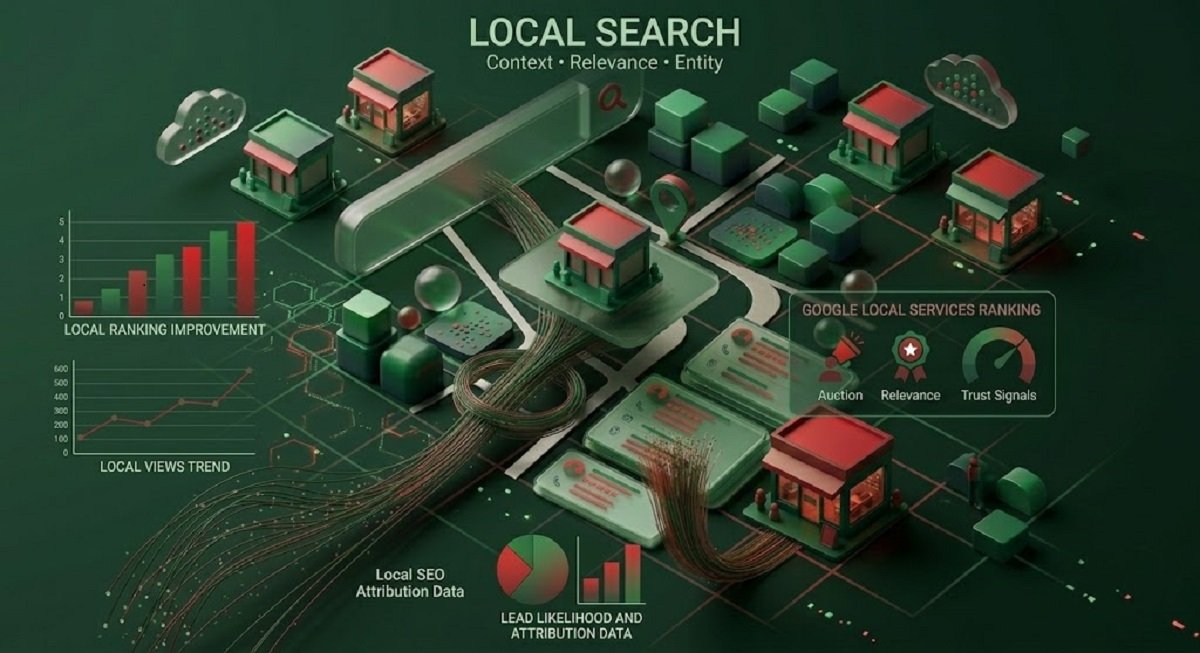
Local search is no longer based on a simple formula such as adding a city name to a webpage or creating a Google Business Profile. Modern search systems evaluate multiple signals to understand what a user is looking for, which businesses are relevant to that need, and how confidently a business can be connected to a specific service and location.
Local search is no longer based on a simple formula such as adding a city name to a webpage or creating a Google Business Profile. Modern search systems evaluate multiple signals to understand what a user is looking for, which businesses are relevant to that need, and how confidently a business can be connected to a specific service and location.
This is where search context, service relevance, and entity signals become important.
When someone searches for a local service, Google has to interpret several layers of information at the same time. It needs to understand the user's search intent, the type of service being requested, the geographic context, and the businesses that may satisfy the query. A strong local search presence depends on how clearly these signals connect.
This technical model helps explain why two businesses in the same market can have very different local search visibility, even when both offer similar services.
Understanding Search Context in Local Search
Search context refers to the information surrounding a search query that helps search engines interpret what the user actually wants.
For example, a user searching for:
-
“emergency plumber”
-
“plumber near me”
-
“water heater repair in Brooklyn”
-
“best plumber for commercial properties”
is communicating different levels of intent.
The core service may be similar, but the context changes the meaning of the search.
Search engines can consider signals such as:
-
The words used in the query
-
Geographic references
-
User location
-
Search history and context
-
Device-related information
-
Business categories
-
Service descriptions
-
Website content
-
Google Business Profile information
-
Reviews and other business references
The goal is not simply to match keywords. Search systems attempt to determine which businesses are most relevant to the specific search context.
This distinction is important for local businesses because visibility can vary depending on the exact search scenario.
A business may have strong visibility for a broad service query but weaker visibility when the search becomes more specific. For example, a company may appear for “HVAC contractor” but have less visibility for “commercial rooftop unit repair.”
That difference can occur because the search context and service relevance are not identical.
What Is Service Relevance?
Service relevance describes how closely a business's information matches the service or need expressed in a user's search.
For local businesses, relevance can be communicated through multiple parts of the digital presence.
These may include:
-
Business categories
-
Service menus
-
Website service pages
-
Page titles and headings
-
Service descriptions
-
Supporting content
-
Structured business information
-
Customer reviews
-
Business attributes
-
Local references
Consider a business that offers several services:
ABC Home Services
Its website might mention plumbing, HVAC, electrical work, and remodeling. However, if the company wants to attract searches for “water heater installation,” the relevant service should be clearly represented within its online presence.
A generic statement such as “We provide complete home services” provides limited service-specific context.
A dedicated page explaining water heater installation, available systems, service areas, common customer questions, and related information provides much stronger semantic context.
This does not mean businesses should create pages simply to insert keywords. The purpose is to make the service offering understandable to both users and search systems.
The Role of Entity Signals
An entity is a recognizable real-world business, organization, place, product, or other identifiable concept.
For local search, a business can function as an entity with multiple connected attributes.
For example:
Business: ABC Plumbing
Service: Plumbing repair
Location: New York
Category: Plumber
Website: Business website
Profile: Google Business Profile
Reviews: Customer feedback
Contact information: Phone, address, and other business details
These connections help establish what the business is and what it does.
Entity signals can come from different sources across the web. When business information is consistent and clearly connected, search engines have more information with which to understand the entity.
This is one reason consistent business information matters in local SEO.
If a company's name, address, phone number, service descriptions, and business category vary significantly across different platforms, the overall entity understanding can become less clear.
Consistency does not guarantee rankings, but accurate and consistent information helps create a stronger digital identity for the business.
Search Context + Service Relevance + Entity Signals
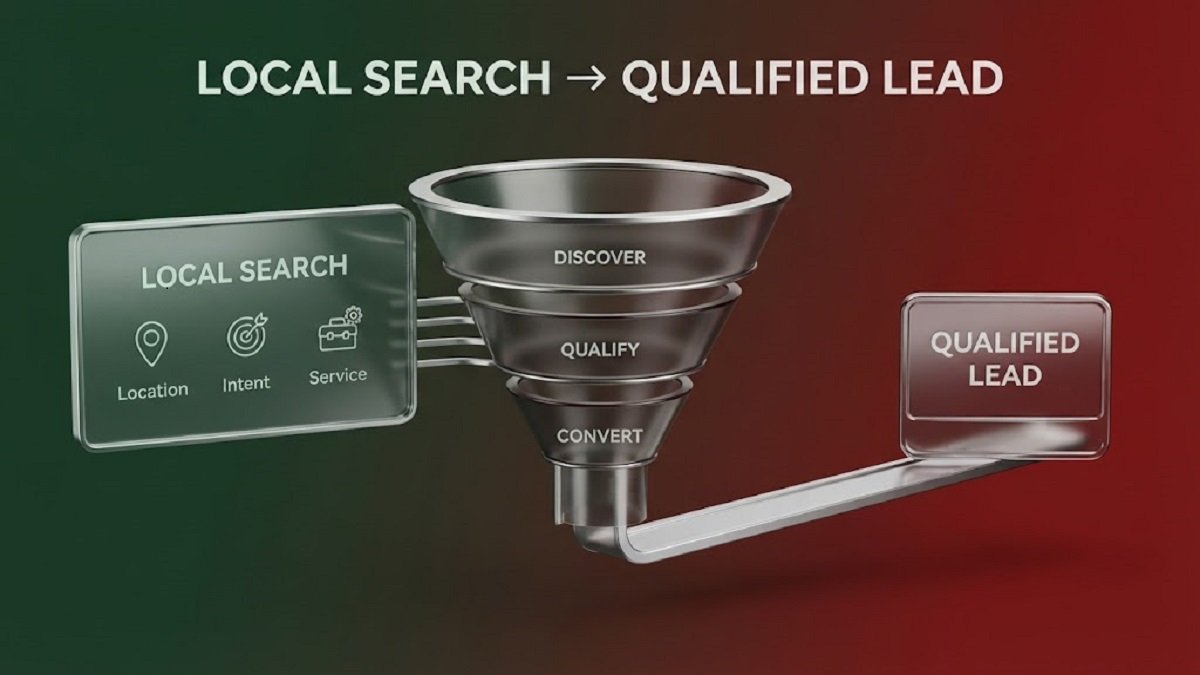
These three concepts can be viewed as connected layers.
Layer 1: Search Context
What is the user searching for?
Layer 2: Service Relevance
Does the business clearly provide the requested service?
Layer 3: Entity Signals
Can the search engine confidently understand and connect the business with that service and location?
For example, imagine someone searches:
“commercial electrician in Queens”
The search contains several contextual signals:
-
Service: electrician
-
Market: commercial
-
Location: Queens
A business that wants to be relevant to this search should clearly communicate that it provides commercial electrical services and serves Queens.
If the business only has a generic homepage saying “professional electrical services,” the relationship may be less explicit.
If the business has clear commercial electrical service information, relevant location information, accurate business details, and supporting entity signals, the relationship becomes easier to understand.
This is the foundation of a more technical local search model.
Why Google Business Profile Matters
Google Business Profile is an important part of a local business's online identity.
Businesses can provide information such as:
-
Business name
-
Primary category
-
Additional categories
-
Services
-
Address or service area
-
Phone number
-
Website
-
Business hours
-
Photos
-
Customer reviews
-
Business attributes
These elements provide structured information about the business.
The primary category can be particularly important because it helps describe the core type of business. Services and additional information can provide further context.
However, businesses should select categories and services that accurately represent what they actually offer.
Adding unrelated services simply because they appear to have search demand can create a poor user experience and does not create a reliable business entity.
Website Content and Service Relevance
A website provides another major source of context.
A local business website should make several things easy to understand:
-
What the business does
-
Which services it provides
-
Which customers it serves
-
Where it operates
-
How customers can contact it
-
Why customers should consider the business
For example, instead of creating one extremely broad page titled “Our Services,” a company with multiple major offerings may organize information into clear service sections or dedicated pages.
A roofing company could have pages covering:
-
Roof repair
-
Roof replacement
-
Commercial roofing
-
Emergency roofing
-
Roof inspections
Each page can explain the specific service rather than repeating the same generic text.
This creates a clearer relationship between the business entity and its individual services.
Location Is Part of Search Context
Local search is inherently geographic.
A service can have completely different search results depending on where the search takes place.
For example:
“dentist”
and
“dentist in Manhattan”
represent different levels of geographic context.
Even searches without an explicit location can have local intent. A query such as “coffee shop near me” depends heavily on the user's location and the businesses operating within the relevant area.
For service-area businesses, geographic relevance can be more complicated because the business may serve customers without having a storefront in every market.
Businesses should therefore communicate their actual service areas clearly through appropriate business information and useful website content.
The goal should be accuracy rather than attempting to create a presence in every possible location.
Reviews as Contextual Business Signals
Customer reviews can provide another layer of information about a local business.
Reviews are primarily written for customers, but they can also contain useful descriptions of the services customers received.
For example, reviews might naturally mention:
-
“water heater repair”
-
“emergency plumbing”
-
“commercial electrical work”
-
“roof replacement”
-
“AC installation”
These references can add contextual information around the business.
However, businesses should never attempt to manipulate customers into inserting specific keywords into reviews.
Authentic customer feedback is more useful than artificial review language.
The focus should remain on delivering a good service and encouraging genuine customer feedback.
Local SEO and Entity Relationships
Effective local SEO is increasingly about creating consistent relationships between a business, its services, and its geographic market.
Think of the online presence as a network:
Business Entity → Service → Location → Supporting Information
For example:
ABC Dental → Cosmetic Dentistry → Chicago → Website + Profile + Reviews + Local References
The more clearly these relationships are represented through accurate information, the easier it becomes to understand the business.
This is why local SEO should not be treated as a collection of isolated tactics.
Creating citations, writing blog posts, optimizing a profile, or adding keywords can be useful in the right context, but these activities work best when they support a coherent business identity.
Common Problems That Weaken Service Relevance
Several issues can make a business's service relationships less clear.
1. Generic Website Content
A website that only says “We are a trusted local company” provides little information about the actual services offered.
2. Overly Broad Service Pages
Combining dozens of unrelated services into one page can make it difficult for users to find specific information.
3. Inconsistent Business Information
Different business names, phone numbers, addresses, or service descriptions across platforms can create unnecessary confusion.
4. Incorrect Categories
Choosing categories that do not accurately describe the business can create a mismatch between the entity and its actual services.
5. Location Overuse
Adding city names repeatedly without useful local information does not automatically create geographic relevance.
6. Keyword-Focused Reviews
Trying to control the wording customers use in reviews can produce unnatural feedback and potentially violate platform guidelines.
A better strategy is to build accurate, useful, and customer-focused information throughout the business's digital presence.
A Technical Framework for Improving Local Search Signals
Businesses can evaluate their local search presence using a simple framework.
Step 1: Define the Core Entity
Identify the business clearly.
What is the official business name?
What type of business is it?
What is its primary service?
Step 2: Map Core Services
Create a list of the actual services offered.
Separate major services when they require substantially different explanations.
Step 3: Connect Services to Locations
Identify the geographic markets the business genuinely serves.
Avoid claiming locations that the business does not actually serve.
Step 4: Review Business Profile Information
Check categories, services, business information, hours, website links, and other profile details for accuracy.
Step 5: Strengthen Website Context
Make sure important service pages clearly explain the service, customer need, process, and relevant geographic information.
Step 6: Maintain Consistency
Compare business information across major platforms and directories.
Correct outdated or inaccurate information where necessary.
Step 7: Analyze Search Intent
Look beyond individual keywords.
Ask:
What does the user actually want to accomplish?
A person searching “emergency AC repair” has a different need from someone searching “AC installation cost.”
Understanding this distinction can improve the relevance of the content created for each audience.
Measuring Local Search Performance
Local visibility should not be evaluated using one metric alone.
Businesses can monitor:
-
Search impressions
-
Website traffic
-
Local search queries
-
Google Business Profile interactions
-
Calls
-
Direction requests
-
Website conversions
-
Service-specific leads
-
Customer engagement
The important question is not simply whether a business receives impressions.
It is whether the visibility is connected to meaningful customer actions.
For example, 1,000 impressions for irrelevant searches may be less useful to a service business than a smaller number of highly relevant searches that generate qualified inquiries.
This is why service relevance and lead quality should be considered alongside visibility.
Why Local Rankings Can Change by Query
Local search results are not necessarily identical for every user or every query.
Search context can change based on factors such as:
-
Query wording
-
Geographic location
-
Service type
-
Business category
-
Search intent
-
Available local businesses
-
Business information
-
Relevance signals
As a result, a company may see different visibility for different services or locations.
This is not necessarily a technical problem.
It can indicate that search systems are evaluating the business against different contextual requirements.
For local marketers, this means performance analysis should be segmented by service, location, and search intent rather than relying only on a single ranking position.
Building a Stronger Local Search Model
A sustainable local search strategy begins with clarity.
The business should be clearly identifiable.
The services should be accurately described.
The locations should be truthful.
The website should provide useful information.
The business profile should remain accurate.
Customer feedback should be authentic.
External references should support the same business identity.
When these elements work together, the digital presence creates a stronger and more understandable relationship between the business and the searches it wants to serve.
This is the practical connection between search context, service relevance, and entity signals.
Key Takeways
Local search has become more contextual and entity-focused. Businesses are no longer competing only by placing a keyword on a webpage.kivabe deteso keyword meta tittle They are building an identifiable digital presence that connects their business entity with specific services, customers, and locations.
Understanding this model can help businesses approach local SEO more strategically.
Instead of asking only, “Which keyword should we rank for?” a better analytical question is:
“Does our digital presence clearly communicate who we are, what we offer, where we operate, and why we are relevant to this specific search?”
That question brings together search context, service relevance, and entity signals.
For businesses focused on long-term local visibility, the objective should be to create accurate, useful, consistent, and service-specific information across their website and local presence. When users and search systems can clearly understand the relationship between a business, its services, and its market, the foundation for stronger local search visibility becomes much clearer.