Reputation Management Vendor Evaluation: What Businesses Should Examine Before Outsourcing
Choosing the right provider requires careful reputation management vendor evaluation. Before outsourcing review monitoring, customer feedback, or brand reputation work, businesses should understand exactly what a vendor provides and how that work will be handled.
A company's online reputation can influence whether potential customers decide to call, visit a website, request a quote, or move on to another business. Reviews are only one part of that picture. Public responses, customer sentiment, business information, and the way complaints are handled can all shape trust.
Outsourcing this work can save time and provide valuable support. But it also gives another company access to an important part of the brand's public communication.
That is why vendor selection deserves careful attention. A structured reputation management vendor evaluation helps businesses look beyond sales promises and examine the actual process behind the service.
The goal is not to find a provider that makes the biggest promises. It is to find one that understands reputation, communicates responsibly, uses appropriate technology, and can work as an extension of the business.
Why Reputation Management Vendor Evaluation Matters Before Outsourcing
Reputation management can involve several ongoing responsibilities.
A vendor may monitor review platforms, track customer feedback, draft responses, identify reputation risks, and provide reports. Some providers may also offer social listening, brand monitoring, or search visibility services.
Each responsibility can affect how customers see the business.
A poor process may result in delayed responses or generic messages. An overly automated system may make customer communication feel impersonal. A provider with weak reporting may also leave management without a clear understanding of what customers are saying.
This is why reputation management vendor evaluation should happen before a contract is signed.
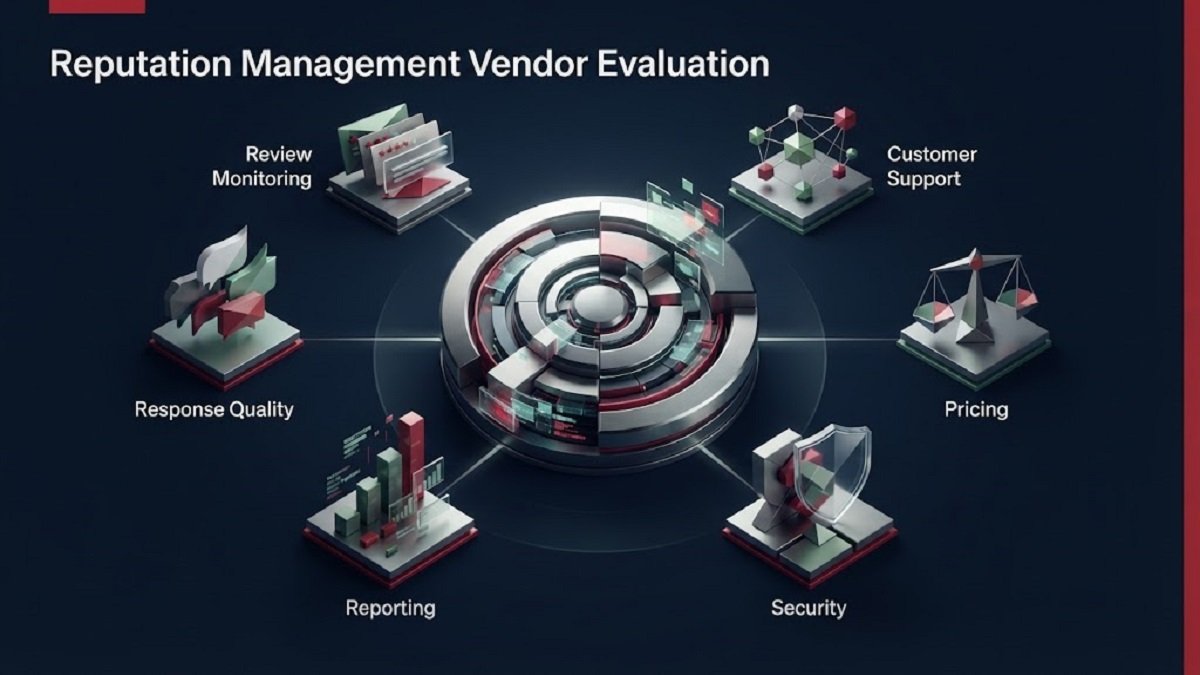
Businesses need to understand not only what a vendor promises, but also how it plans to deliver the service. The evaluation should cover the provider's experience, workflow, communication, reporting, technology, security, and pricing.
A strong evaluation can prevent misunderstandings and make it easier to choose a provider that fits the company's actual needs.
Start by Reviewing the Vendor's Own Reputation
A simple starting point is to examine the vendor's reputation.
If a company manages online reviews for other businesses, its own online presence should receive some attention too.
Search for the vendor's business name.
Read reviews from current or previous customers.
Look for feedback across more than one platform when possible.
Do not focus only on the average rating.
Pay attention to how the vendor responds to criticism.
Does it answer difficult questions professionally?
Does it acknowledge legitimate concerns?
Does it explain issues clearly?
Does it attempt to resolve problems?
Or does it become defensive when customers disagree?
A perfect review score is not necessarily the most important signal.
The response to criticism can be more revealing.
During a reputation management vendor evaluation, businesses should examine whether the provider follows the same communication standards it recommends for clients.
A vendor that demonstrates patience and professionalism when dealing with its own customers may be better prepared to represent another company's brand.
Define What Reputation Management Actually Includes
One of the biggest mistakes businesses make is assuming that every reputation management package is the same.
It is not.
Some vendors focus on review monitoring.
Others manage review responses.
Some provide customer feedback analysis.
Others combine reputation work with social media monitoring, search visibility, or broader digital marketing.
Before choosing a provider, ask for a detailed list of services.
Find out whether the vendor will:
-
Monitor Google reviews
-
Monitor other major review platforms
-
Draft or publish review responses
-
Track changes in ratings
-
Analyze customer sentiment
-
Identify recurring complaints
-
Monitor brand mentions
-
Escalate serious issues
-
Provide regular reports
-
Coordinate with customer service
-
Help identify suspicious or policy-violating reviews
The answer to each question can affect the overall value of the service.
A clear scope also makes it easier to compare different vendors. It gives management a practical foundation for reputation management vendor evaluation instead of relying on vague package descriptions.
Evaluate How Review Responses Are Created
Review responses are public communication.
Anyone can read them.
A potential customer may see a complaint first and then decide whether the company's response changes their perception.
That makes the response process an important part of vendor evaluation.
Ask who writes the responses.
Are they created by employees?
Are templates used?
Does artificial intelligence assist with drafting?
Does a human review each response?
Does the business have approval before publication?
These questions matter because every customer situation is different.
A generic response may sound efficient, but it can also make the company appear disconnected from the person who left the review.
A stronger process combines consistency with personalization.
The response should fit the company's voice while addressing the customer's actual concern.
When conducting reputation management vendor evaluation, businesses should therefore look at the complete response workflow rather than simply asking whether responses are included in the package.
Ask How Negative Reviews Are Handled
No business can guarantee that every customer will be satisfied.
Negative feedback is part of doing business.
The important question is how it is handled.
A responsible vendor should distinguish between different types of negative reviews.
A legitimate complaint may require a service recovery conversation.
An inaccurate claim may require a calm clarification.
A review that violates a platform's rules may be eligible for reporting.
These situations should not all receive the same response.
Be especially careful with vendors that promise to remove all negative reviews.
Legitimate criticism cannot simply be deleted because a business dislikes it.
A professional provider should explain what can realistically be done and what remains outside its control.
Good reputation management is about responsible communication, not hiding every criticism.
This distinction should be a major part of reputation management vendor evaluation, because unrealistic promises can create bigger problems later.
Look for Transparency in Reporting
Businesses should know what they are paying for.
That means reporting should be clear and useful.
Ask how often reports are provided.
Find out what information they contain.
A useful report may include:
-
New reviews
-
Rating changes
-
Review volume
-
Response activity
-
Common complaints
-
Customer sentiment
-
Emerging reputation issues
-
Recommended actions
The report should help management understand what is happening.
For example, if negative comments about communication are increasing, the business should be able to identify that pattern.
If positive reviews repeatedly mention a particular employee or service feature, that information can also be useful.
Numbers are valuable when they lead to better decisions.
A report full of charts without practical insight may not provide much value.
Reporting should therefore be included when comparing vendors. A complete reputation management vendor evaluation should determine whether the provider reports activity or actually explains what the data means.
Check Whether the Vendor Understands Your Industry
Customer expectations vary by industry.
A restaurant may receive reviews about food, service speed, cleanliness, or staff behavior.
A home service business may receive feedback about scheduling, pricing, workmanship, and communication.
A professional service firm may face complaints about deadlines, responsiveness, or unclear expectations.
A healthcare-related business may need an even more careful approach to customer communication.
Ask potential vendors whether they have worked with similar companies.
However, industry experience should not be the only consideration.
The vendor should also take time to understand your business.
A provider that learns how your customers think and what your employees actually do will usually be better positioned to communicate on your behalf.
Industry knowledge should therefore be part of your reputation management vendor evaluation, but it should be assessed alongside process quality and communication standards.
Use a Reputation Management Review to Assess the Vendor's Process
A Reputation Management Review should examine more than the number of positive reviews a business has.
It should also examine the systems behind the reputation.
How quickly are new reviews identified?
How are responses handled?
Are serious complaints escalated?
Are repeated problems tracked?
Does customer feedback reach the right department?
Are management reports easy to understand?
These questions help reveal whether the vendor is managing reputation as an ongoing business function or simply performing isolated tasks.
A good vendor should help the business understand patterns.
For example, repeated complaints about slow communication may indicate a customer service issue.
Repeated complaints about missed appointments may point to an operational problem.
Reputation data becomes more valuable when it helps management identify and address the cause.
For that reason, a reputation management vendor evaluation should look at whether the provider can turn review information into useful business insight.
Consider the Connection With Local Search
For businesses that rely on customers in specific locations, reputation management can also connect with local search visibility.
A customer may search for a business, compare several local options, read reviews, check business information, and then visit a website.
That journey involves both visibility and trust.
This is where Local SEO can support reputation work in a natural way. Accurate business information, consistent local profiles, relevant service content, and trustworthy customer signals can help create a clearer online presence for businesses serving specific markets.
When evaluating a vendor, ask whether its reputation work fits with your broader local search strategy.
The services do not necessarily need to come from the same company.
What matters is that different parts of the digital presence communicate accurate and consistent information.
A strong reputation management vendor evaluation should consider this connection when a business depends heavily on local customers and location-based searches.
Examine Communication and Escalation
Outsourcing does not mean giving up visibility.
A business should know when important issues appear.
Ask how the vendor handles urgent complaints.
For example, a routine review may be included in a regular report.
A serious allegation or major customer complaint may require immediate attention.
The vendor should have a clear escalation process for these situations.
Ask:
-
Who receives urgent alerts?
-
How quickly are serious issues reported?
-
Who approves sensitive responses?
-
What happens outside normal business hours?
-
Who is the main point of contact?
Clear communication can prevent small reputation issues from becoming larger problems.
Communication standards should be documented during the reputation management vendor evaluation process so both sides understand their responsibilities before work begins.
Understand the Role of Automation
Modern reputation platforms can monitor large amounts of customer feedback quickly.
Automation can identify new reviews.
Software can organize feedback.
AI tools can help identify sentiment or summarize common themes.
These tools can be useful.
But they should not replace human judgment.
A customer may use sarcasm.
A complaint may contain important context.
A sensitive issue may require a carefully written response.
Ask potential vendors which tasks are automated and which receive human review.
A balanced approach often works best.
Technology can help the vendor identify information quickly.
Human judgment can then determine what that information means and how the business should respond.
As part of reputation management vendor evaluation, ask the provider to explain exactly where automation ends and human oversight begins.
Review Account Access and Data Protection
Reputation work may require access to business profiles and other online accounts.
That access should be handled carefully.
Before signing a contract, ask what permissions the vendor needs.
Does it need full administrative access?
Can access be limited?
Who can view customer information?
How is business data stored?
What happens when the contract ends?
These questions help protect the company's digital assets.
The business should maintain appropriate ownership and control over important accounts.
A vendor should be given enough access to perform its responsibilities without receiving unnecessary control.
Account security should be treated as an essential part of reputation management vendor evaluation, particularly when several employees or contractors may have access to business profiles.
Compare Vendors Based on Scope, Not Price Alone
Price is important, but it should not be the only factor.
A low-cost package may provide basic monitoring.
Another provider may include human review responses, reporting, escalation, sentiment analysis, and strategic recommendations.
Compare the actual scope of each service.
Ask:
-
What is included in the monthly fee?
-
How often are reviews monitored?
-
Are responses included?
-
Are reports included?
-
Are there setup fees?
-
Are additional locations charged separately?
-
Is there a minimum contract period?
-
What happens if the business cancels?
A clear comparison can prevent unexpected costs.
It can also help management determine whether the vendor's service matches the actual workload.
The purpose of reputation management vendor evaluation is not simply to find the cheapest provider. It is to determine which provider offers the right combination of service, quality, communication, and value.
Be Careful With Unrealistic Guarantees
Reputation is influenced by real customer experiences.
That makes certain promises difficult to justify.
Be cautious if a vendor guarantees:
-
Every negative review will disappear
-
A perfect rating will be achieved
-
Search results will change immediately
-
Competitors' reviews can be removed
-
Reputation problems can be fixed without improving customer experience
-
Major results will appear within a few days
A responsible vendor should set realistic expectations.
It should explain what it can influence and what it cannot control.
Honest communication before the contract is usually a better sign than aggressive promises designed to close a sale.
During reputation management vendor evaluation, unrealistic guarantees should be treated as warning signs rather than advantages.
Ask for a First-90-Day Plan
Before entering a long-term relationship, ask what the vendor plans to accomplish during the first 90 days.
The first phase may involve an audit.
The vendor can review existing reviews, major platforms, response gaps, customer complaints, business information, and reputation risks.
The next phase may focus on setting up monitoring and response processes.
Later, the vendor can analyze trends and recommend improvements.
A clear plan gives the business something practical to evaluate.
Instead of asking only whether the vendor can improve the company's reputation, ask:
What will you review, what will you change, what will you measure, and what should we expect to learn during the first 90 days?
The answers can reveal how prepared the provider really is.
This 90-day plan can also serve as a practical benchmark for the reputation management vendor evaluation process.
Build a Reputation Management Vendor Evaluation Checklist
A simple checklist can make the final decision easier.
Experience
-
Does the vendor have relevant experience?
-
Does it have credible customer feedback?
-
Does it understand your industry?
-
Does it communicate professionally?
Services
-
Which platforms are monitored?
-
Are review responses included?
-
Is customer sentiment analyzed?
-
Are serious complaints escalated?
Reporting
-
How often are reports delivered?
-
What information is included?
-
Are trends explained?
-
Are recommendations provided?
Technology
-
Which tasks are automated?
-
Which tasks receive human review?
-
How are reviews monitored?
-
How is feedback analyzed?
Security
-
What account access is required?
-
How is customer information handled?
-
Who can access business data?
-
What happens when the contract ends?
Pricing
-
What is included?
-
Are there additional fees?
-
Is there a minimum contract period?
-
Can the service scale with the business?
Using a checklist helps businesses compare providers based on facts rather than sales language. It also makes the reputation management vendor evaluation process more consistent when several providers are being considered.
The Best Vendor Should Help Find the Root Cause
A strong reputation management partner should not focus only on improving visible numbers.
It should help the business understand why customers are responding in a certain way.
If reviews repeatedly mention poor communication, management should investigate communication.
If customers complain about missed appointments, operations may need improvement.
If customers cannot find accurate business information, the company's online presence may need attention.
This is where reputation data becomes useful for the wider business.
The best vendor should help identify patterns, explain what they may mean, and recommend practical next steps.
The purpose is not to cover up problems.
It is to understand them and respond responsibly.
That is also an important standard for reputation management vendor evaluation. A provider that only reports ratings may be less valuable than one that helps management understand the reasons behind those ratings.
Final Thoughts
A thorough reputation management vendor evaluation can help businesses make a more informed outsourcing decision.
The right provider should offer clear services, professional review responses, useful reporting, realistic expectations, responsible account access, and strong communication.
Before signing a contract, examine the vendor's own reputation.
Understand exactly what it will manage.
Ask how negative reviews are handled.
Review its reporting process.
Understand the role of automation.
Check account permissions and data practices.
Compare vendors based on actual scope rather than price alone.
Most importantly, choose a provider that understands reputation as a long-term trust issue.
A good vendor should not promise to make every negative comment disappear.
Instead, it should help the business listen to customers, respond thoughtfully, identify recurring problems, and improve the experience behind the online reputation.
That makes reputation management more than an outsourced marketing task.
It becomes a practical way to protect customer trust while building a stronger and more credible brand.
Frequently Asked Questions
1. What is reputation management vendor evaluation?
Reputation management vendor evaluation is the process of comparing providers before outsourcing online reputation work. It can include reviewing their experience, services, response process, reporting, technology, security practices, pricing, and communication standards.
2. What should businesses ask a reputation management vendor?
Businesses should ask what platforms the vendor monitors, how review responses are created, how negative feedback is handled, what reports are provided, how urgent complaints are escalated, what account access is required, and what is included in the pricing. These questions make reputation management vendor evaluation more practical and objective.
3. Can Local SEO and reputation management work together?
Yes. Businesses that depend on local customers often need both strong search visibility and customer trust. Consistent business information, accurate local profiles, relevant content, and positive customer experiences can support both reputation and the broader local search journey.