
Reputation Management After a Business Acquisition: Protecting Customer Trust
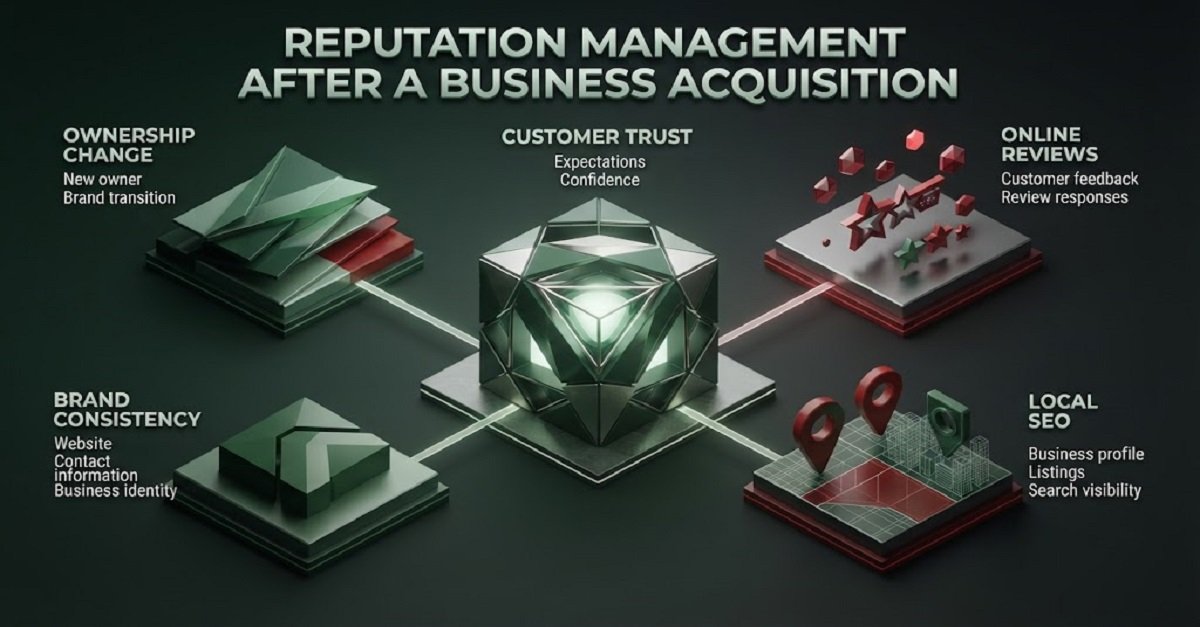
Reputation management after a business acquisition should begin as soon as the ownership transition is planned. A business acquisition can be an exciting new chapter. A new owner may bring fresh ideas, better resources, new technology, or a stronger growth plan. The acquisition may also create opportunities to expand services and reach new customers.
But there is one thing that should never be treated as a minor detail: customer trust.
When ownership changes, customers may immediately have questions. Will the business still provide the same service? Will the employees stay? Will the quality change? Will the company keep its name? Will existing customers still receive the same level of support?
These questions can affect how people talk about the business online.
That is why reputation management after a business acquisition should be part of the transition plan from the beginning. It should not be something addressed months later after confusion has already spread.
A smooth ownership transition is not only about transferring assets, contracts, and operations. It is also about protecting the relationship the previous business built with its customers.
Why Business Acquisitions Can Affect Online Reputation
Customers often become uncertain when they hear that a business has been acquired.
Even when the acquisition is positive, the change can create a gap between what customers knew before and what they see now.
For example, an established local company may have spent years building:
-
Positive customer reviews
-
Strong word-of-mouth referrals
-
Brand recognition
-
Local search visibility
-
A trusted business name
-
A consistent service reputation
-
Relationships with long-term customers
After an acquisition, some of these signals may become inconsistent.
The website may show the new owner's information while old directories still show the previous owner. The business profile may have outdated details. Customers may ask questions in reviews. Some may even assume that the business has changed completely.
This makes reputation management after a business acquisition an important part of protecting the trust a company has built over time.
The goal is not to hide the acquisition.
The goal is to manage the transition clearly and protect customer confidence while the brand evolves.
What Customers Actually Want to Know
Most customers do not need a complicated explanation of the acquisition.
They want reassurance.
They want to know that the business they trusted is still reliable.
A simple message can answer many of their concerns:
-
The business is under new ownership.
-
The team remains committed to quality.
-
Existing services will continue.
-
Customer relationships still matter.
-
The company is investing in improving the customer experience.
Clear communication can prevent unnecessary speculation.
Without it, customers may create their own assumptions.
And assumptions can quickly appear in online reviews, social media comments, community discussions, and search results.
Reputation Management After a Business Acquisition Starts With Communication
The first step is to communicate the transition clearly.
This communication should be consistent across the business website, business profiles, social media accounts, email communication, and other important channels.
This is where reputation management becomes especially important during an ownership transition.
The exact message will depend on the acquisition.
If the name is staying the same, explain that.
If the name is changing, explain why.
If the location, services, or team are changing, provide clear information.
Most importantly, avoid making customers feel that something happened behind closed doors.
Transparency creates confidence.
For example, instead of quietly changing the company information everywhere, the new ownership can publish a short announcement explaining the transition and reaffirming its commitment to customers.
That creates a reference point customers can return to when they have questions.
Protect Existing Reviews During the Transition
Reviews are one of the most valuable parts of an established business reputation.
They represent years of customer experiences.
An acquisition does not erase that history.
However, a transition can create confusion around how those reviews should be understood.
Suppose a local service company has hundreds of reviews under its existing business name. A new owner takes over and immediately creates a new business profile instead of properly managing the existing presence.
Now customers may see two profiles.
One has years of reviews.
The other is almost empty.
This can make the business look newer than it really is.
It can also create uncertainty about which profile customers should trust.
Before making major changes, businesses should carefully review their existing profiles, listings, website information, and customer feedback.
The objective should be to preserve legitimate reputation signals while ensuring that current information is accurate.
Managing these reviews carefully is an important part of reputation management after a business acquisition, because historical customer experiences still influence how new customers view the company.
Do Not Treat Old Reviews as Someone Else's Problem
One common mistake after an acquisition is assuming that previous reviews no longer matter.
They do.
A potential customer may read reviews from several years ago before deciding whether to contact the business today.
Those reviews form part of the brand's public history.
However, the new owner should not pretend to be the person who provided the previous service.
Instead, responses can acknowledge the historical review while making it clear that the business is now under new ownership when relevant.
This creates a balance between respecting the company's history and being transparent about its current identity.
This approach makes reputation management after a business acquisition more transparent and helps customers understand the connection between the company's past and present.
Review Responses Matter More During a Brand Transition
A business acquisition can increase the importance of review responses.
Customers may use reviews to ask questions about the transition.
For example:
“Is this still the same company?”
“Did the ownership change?”
“Are you still serving this area?”
“Is the original team still here?”
These questions should not be ignored.
A professional response can reduce uncertainty and show that the new management is paying attention.
The response does not need to be long.
It needs to be accurate, calm, and helpful.
That is especially important when a review contains criticism related to the previous ownership.
The new team should avoid blaming the former owner or arguing with the customer.
Instead, acknowledge the concern and focus on what the current business can do to help.
Strong communication is a key part of reputation management after a business acquisition, especially when customers are trying to understand what has changed.
Keep Business Information Consistent
An acquisition often creates an unexpected SEO challenge.
Different websites may contain different versions of the business information.
For example:
-
The website has a new phone number.
-
An old directory has the previous number.
-
A business profile shows an outdated address.
-
A social profile still lists the former owner.
-
An industry directory uses an old business description.
Individually, these may seem like small problems.
Together, they create confusion.
Search engines rely on information from many sources to understand businesses and their locations. Consistent information helps create a clearer digital identity.
This is why Local SEO should be considered part of the transition rather than an unrelated marketing task.
A business acquisition is a good time to audit important online information and identify outdated or conflicting details.
How SEO Supports a Reputation Transition
SEO is not only about rankings.
It also helps search engines and customers understand what a business is, where it operates, and what it offers.
After an acquisition, that understanding may need to be updated.
A proper SEO review can include:
-
Website business information
-
Business name and contact details
-
Location pages
-
Service pages
-
Business profile information
-
Structured data
-
Internal links
-
Directory listings
-
Relevant third-party references
-
Branded search results
The goal is to create consistency.
When someone searches for the business, they should not have to figure out which information is current.
The website should clearly represent the current business.
The business profile should match.
Important external listings should be reviewed.
And outdated information should be corrected where possible.
Reputation management after a business acquisition also helps businesses maintain a consistent message across their website, business profiles, and customer-facing channels.
A Business Name Change Needs Extra Attention
Some acquisitions involve a complete rebrand.
That can be more complicated.
Imagine a company called ABC Paving is acquired and becomes NorthStar Paving.
Customers may still search for “ABC Paving.”
Some may not immediately recognize NorthStar Paving as the same business.
If the old brand suddenly disappears from the website and search results, the transition can create unnecessary confusion.
A better approach is to explain the relationship clearly.
For a reasonable transition period, the website may explain that:
ABC Paving is now NorthStar Paving.
This connects the old identity with the new one.
It also helps existing customers understand that the company did not simply disappear.
The transition should be reflected consistently across important online properties.
Do Not Erase the Company's History
A rebrand does not require erasing the past.
In fact, the history of an established company can be one of its strongest trust signals.
Years of completed projects, customer experiences, industry knowledge, and community presence can help demonstrate credibility.
The new ownership should build on that history while making its current direction clear.
For example, a website can explain the company's experience and then introduce the new leadership.
This tells customers:
The business has changed ownership, but its experience and commitment did not disappear overnight.
That distinction can make a major difference.
Monitor Customer Sentiment After the Acquisition
Reputation management should continue after the announcement.
The weeks and months following an acquisition can reveal how customers are reacting.
Monitor:
-
New reviews
-
Review ratings
-
Customer questions
-
Social media comments
-
Branded search results
-
Website feedback
-
Customer support complaints
-
Repeated concerns about the transition
Look for patterns.
If several customers mention longer response times, that may indicate an operational problem.
If customers repeatedly ask whether the old team is still available, communication may need to improve.
If reviews suddenly mention declining quality, management should investigate whether there is a real service issue behind the trend.
Regular monitoring makes reputation management after a business acquisition an ongoing process rather than a one-time task.
Reputation monitoring should not simply measure sentiment.
It should help management identify problems early.
Negative Reviews Should Be Handled Carefully
An acquisition does not guarantee that every customer will be satisfied.
Some customers may dislike the change.
Others may have experienced service problems during the transition.
A negative review can feel personal, especially when the new owner is working hard to improve the business.
But public arguments rarely help.
A better response is professional and specific.
Acknowledge the concern.
Avoid unnecessary excuses.
Do not attack the previous owner.
Do not reveal private customer information.
If the issue requires investigation, invite the customer to continue the conversation privately.
The public response should demonstrate professionalism to both the reviewer and everyone else reading it.
Build Trust Through Consistency
Customers often become comfortable with a business because of consistency.
They know what to expect.
The staff behaves a certain way.
The service follows a familiar process.
The company communicates clearly.
The online information matches the real-world experience.
An acquisition can disrupt some of these expectations.
That is why the new ownership should focus on creating consistency as quickly as possible.
The website should reflect the current business.
The business profile should be accurate.
Employees should understand the new messaging.
Customer service should know how to explain the transition.
Review responses should follow a consistent but human tone.
Marketing materials should not contradict the company's public information.
This consistency reduces uncertainty.
Consistent communication also strengthens reputation management after a business acquisition by giving customers a reliable source of current information.
Reputation Management Is Also About Employee Alignment
Customers are not the only people affected by an acquisition.
Employees are part of the brand experience.
If employees give different answers about the acquisition, customers may become confused.
For example, one employee may say the business has completely changed, while another says everything is exactly the same.
Neither message may be intentional.
It may simply mean that the internal communication was incomplete.
Before promoting the new ownership publicly, management should make sure employees understand:
-
What has changed
-
What has stayed the same
-
How to answer customer questions
-
How to explain new services
-
Who handles complaints
-
What information should be shared publicly
A consistent internal message supports a consistent external reputation.
Use the Acquisition as an Opportunity to Improve
A business transition does not have to be treated only as a risk.
It can also be an opportunity.
The new owner can review the company's reputation and identify areas that were previously neglected.
Perhaps old reviews were never answered.
Maybe the website was outdated.
Perhaps important services were difficult to find.
Maybe the business profile contained incorrect information.
The acquisition creates a natural reason to review these areas.
Instead of simply preserving the old reputation, the new team can build on it.
The objective should be:
Preserve what customers already trust while improving what needs to change.
That is a much stronger long-term strategy than trying to make the business look completely new.
Create a Reputation Transition Checklist
A structured checklist can make the process easier.
Before the Acquisition Becomes Public
Review the existing digital presence.
Document important business profiles.
Identify major review platforms.
Record current business information.
Review existing customer sentiment.
Identify potential reputation risks.
During the Transition
Communicate the ownership change clearly.
Update the website.
Review business profile information.
Correct important business listings.
Monitor customer questions.
Respond to new reviews professionally.
After the Transition
Track review trends.
Monitor branded searches.
Review customer feedback regularly.
Update outdated information.
Improve website content where needed.
Continue building genuine customer relationships.
Including these steps in the transition plan can make reputation management after a business acquisition easier to manage over the long term.
This creates an ongoing process rather than a one-time cleanup.
When Reputation and SEO Work Together
Reputation and SEO are often treated as separate marketing activities.
In practice, they can influence the same customer journey.
A potential customer may search for a business name.
They may see reviews.
Then they may visit the website.
They may check the location.
They may read customer feedback.
Finally, they decide whether to call.
Every step contributes to trust.
If the information is inconsistent, the customer may hesitate.
If the information is accurate and the reputation is strong, the decision becomes easier.
That is why a post-acquisition SEO strategy should not focus only on rankings. It should also consider the quality and consistency of the information customers encounter.
For this reason, reputation management after a business acquisition should work alongside SEO to create a consistent and trustworthy customer experience.
Building a Stronger Reputation After the Transition
A successful transition should not end once the basic business information has been updated.
The new ownership should continue improving the customer experience and watching how the brand is represented online.
That means paying attention to review trends, customer questions, search visibility, business listings, and website content over time.
Reputation management after a business acquisition works best when it becomes part of the company's long-term approach to customer communication and digital presence.
When these areas remain aligned, customers are less likely to feel confused by the ownership change. They can understand what has changed, what remains the same, and why they can continue to trust the business.
Final Thoughts
A business acquisition changes ownership.
It does not automatically change customer expectations.
People still want reliable service, clear communication, and a reason to trust the company.
That is why reputation management after a business acquisition should be treated as a core part of the transition.
Protect the legitimate history of the business.
Communicate the changes clearly.
Keep business information consistent.
Monitor reviews and customer sentiment.
Use SEO to strengthen the connection between the current brand and its online presence.
Most importantly, give customers a reason to believe that the transition is being handled responsibly.
A successful acquisition is not simply measured by how smoothly ownership changes hands.
It is also measured by whether customers feel confident staying with the business after the change.
When a new owner respects the old reputation while building a stronger future, a brand transition can become more than a risk.
It can become an opportunity to earn even greater trust.
Frequently Asked Questions
1. What happens to a business's reputation after an acquisition?
A business acquisition can create uncertainty among existing and potential customers. They may wonder whether the service, team, quality, or business identity has changed. Clear communication and accurate online information can help maintain customer confidence during the transition.
2. How can new owners protect existing customer trust?
New owners can protect customer trust by respecting the company's history while clearly communicating what has changed. They should maintain accurate business information, monitor reviews, respond to customer concerns, and make sure the website and business profiles reflect the current ownership.
3. How does SEO support reputation management after a business acquisition?
SEO helps keep the business's online information clear and consistent. Updating the website, business profiles, location information, and relevant listings can help customers find the correct information and understand the current identity of the business.