Customer Feedback Analysis: From Reputation Monitoring to Business Intelligence

Customer feedback is more than a reputation signal. Customer Feedback Analysis helps businesses look beyond review counts, ratings, and individual complaints to identify recurring problems inside the customer experience. A comment about delayed service, unclear pricing, slow communication, or poor follow-up may point to a deeper operational weakness. When these patterns are analyzed across customers and channels, feedback can become a valuable source of business intelligence rather than simply a measure of online reputation.
But that is only one layer of the information customers are providing.
A review that says a service was delayed is not simply a negative comment. It may point to a scheduling problem. Several customers mentioning slow responses may reveal a communication gap. Repeated complaints about unclear pricing may indicate a sales process problem rather than a customer-service problem.
This is where Customer Feedback Analysis becomes more valuable.
Instead of simply asking how many positive or negative reviews a business has, advanced businesses ask a more important question:
What are customers repeatedly telling us about how the business actually operates?
That shift turns reputation monitoring into a form of business intelligence.
Customer Feedback Contains More Than Reputation Signals
A customer review represents an experience.
That experience is influenced by many parts of the business, including communication, scheduling, pricing, service delivery, staff behavior, product quality, follow-up, and expectations.
When customers repeatedly mention the same issue, the feedback can become evidence of an operational pattern.
For example, imagine a home-service company receiving comments such as:
-
“It took several days to hear back.”
-
“The estimate was difficult to understand.”
-
“The technician arrived later than expected.”
-
“I had to call twice for an update.”
Individually, these may look like separate complaints.
Together, they suggest something more significant.
The company may have weaknesses in response management, scheduling communication, and customer follow-up.
This is why Customer Feedback Analysis should not stop at classifying feedback as positive or negative. The real value comes from understanding what the feedback reveals about the business behind the customer experience.
The Difference Between Monitoring and Business Intelligence
Reputation monitoring usually focuses on visibility.
A business may track:
-
Review ratings
-
New reviews
-
Review volume
-
Customer sentiment
-
Response rates
-
Complaint themes
-
Brand mentions
These metrics are useful.
However, monitoring tells a business what is happening. Business intelligence tries to determine why it is happening and what should change.
Consider a business whose average review rating falls slightly over several months.
A monitoring system may identify the decline.
A deeper analysis may reveal that the decline is concentrated around one specific issue, such as delayed communication after a customer requests an estimate.
That discovery changes the response.
The company does not necessarily need a broad reputation campaign. It may need a better lead-response process.
The distinction is important:
Monitoring observes the signal. Intelligence interprets the pattern. Operations act on the insight.
Look for Recurring Problems, Not Isolated Complaints
One of the biggest mistakes businesses make with customer feedback is reacting to individual comments without looking for repetition.
Every business can receive an unreasonable complaint.
Every business can experience an occasional mistake.
The more useful signal appears when the same type of problem shows up across multiple customers, locations, employees, services, or time periods.
For example, one customer saying “the staff was slow” may not prove a systemic problem.
But if customers repeatedly describe:
-
slow responses,
-
unanswered messages,
-
delayed updates,
-
unclear next steps,
the business has a stronger reason to investigate its communication process.
This is where Customer Feedback Analysis becomes a pattern-recognition exercise.
The objective is not to treat every complaint as a crisis.
The objective is to determine which complaints represent isolated events and which represent recurring operational weaknesses.
Turn Customer Language Into Operational Categories
Customers rarely describe business problems using management terminology.
They describe what they experienced.
A customer may say:
“Nobody called me back.”
An operations manager might interpret that as a lead follow-up failure.
A customer might say:
“The final price was much higher than I expected.”
The underlying issue could involve pricing communication or expectation setting.
Another customer might say:
“I wasn't sure what was happening after I paid.”
That may indicate a post-purchase communication gap.
Advanced Customer Feedback Analysis translates customer language into operational categories.
Useful categories may include:
Communication
Look for repeated mentions of unanswered calls, slow responses, unclear updates, or difficulty reaching staff.
Scheduling
Identify complaints involving delays, missed appointments, inconsistent timing, or poor coordination.
Pricing
Look for unexpected costs, unclear estimates, confusing packages, or perceived differences between quoted and final prices.
Service Delivery
Analyze comments about incomplete work, inconsistent quality, missed details, or failure to meet expectations.
Customer Support
Look for repeated difficulty resolving issues, poor follow-up, or customers needing to contact the business multiple times.
Expectation Management
Identify situations where the business delivered something technically acceptable but the customer expected something different.
These categories help turn unstructured feedback into information that management teams can act on.
The Most Valuable Signal May Be Repetition Across Channels
Customers do not always leave their feedback in one place.
They may use review platforms, contact forms, social media, email, surveys, support conversations, or direct messages.
That creates an important analytical challenge.
A business may see only part of the problem if it examines one channel independently.
For example, public reviews might contain several comments about slow communication, while private support conversations contain even more examples of the same problem.
The public reputation signal is only the visible portion.
The operational pattern may be much larger.
This is why businesses should look for cross-channel repetition.
If customers describe the same weakness in different environments, confidence in the underlying pattern becomes stronger.
That does not mean every complaint should be combined automatically. Context matters.
But repeated language across independent customer touchpoints can reveal problems that a review dashboard alone may not show.
Separate Symptoms From Root Causes
A strong feedback program should not stop at identifying the visible complaint.
It should ask:
What process could be creating this experience?
Suppose customers repeatedly complain about slow service.
“Slow service” is the symptom.
The root cause could be:
-
understaffing,
-
poor scheduling,
-
inefficient routing,
-
unclear internal responsibilities,
-
unrealistic appointment capacity,
-
delayed approvals,
-
weak communication between teams.
The same customer complaint can therefore have multiple possible causes.
This is where Customer Feedback Analysis becomes closer to operational analysis than traditional reputation management.
The goal is not to guess the cause from one comment.
The goal is to compare feedback patterns with internal processes and determine where the customer experience is breaking down.
Feedback Can Reveal Problems Before Revenue Does
One of the most useful advantages of customer feedback is timing.
Operational problems may exist long before they become obvious in financial reports.
A business might still be generating revenue while customers are increasingly frustrated by slow communication.
Repeat customers may continue purchasing while new customers struggle with the onboarding process.
Sales may remain stable even though complaints about scheduling are increasing.
Feedback can therefore act as an early-warning system.
A growing pattern of small complaints may indicate a larger operational problem that has not yet produced a dramatic business outcome.
This makes customer feedback especially valuable for businesses experiencing growth.
The larger the operation becomes, the easier it is for small process failures to multiply.
Use Feedback Trends to Prioritize Operational Fixes
Not every issue deserves the same response.
A useful analysis should help management prioritize.
One practical approach is to evaluate each recurring issue across four dimensions:
Frequency: How often does the problem appear?
Impact: How seriously does it affect the customer experience?
Business risk: Could it affect retention, referrals, conversions, or reputation?
Controllability: Can the business realistically improve the underlying process?
For example, a recurring complaint about confusing appointment confirmations may appear frequently, have moderate customer impact, create avoidable support calls, and be relatively easy to fix.
That could become a higher operational priority than a rare complaint about an issue the business cannot fully control.
The purpose of Customer Feedback Analysis is therefore not to produce the longest list of complaints.
It is to identify the problems worth solving first.
Reputation Management Becomes More Strategic
Once feedback starts informing operational decisions, reputation management changes.
It is no longer simply about protecting the public image of a company.
It becomes connected to how the company actually delivers its service.
This creates an important feedback loop:
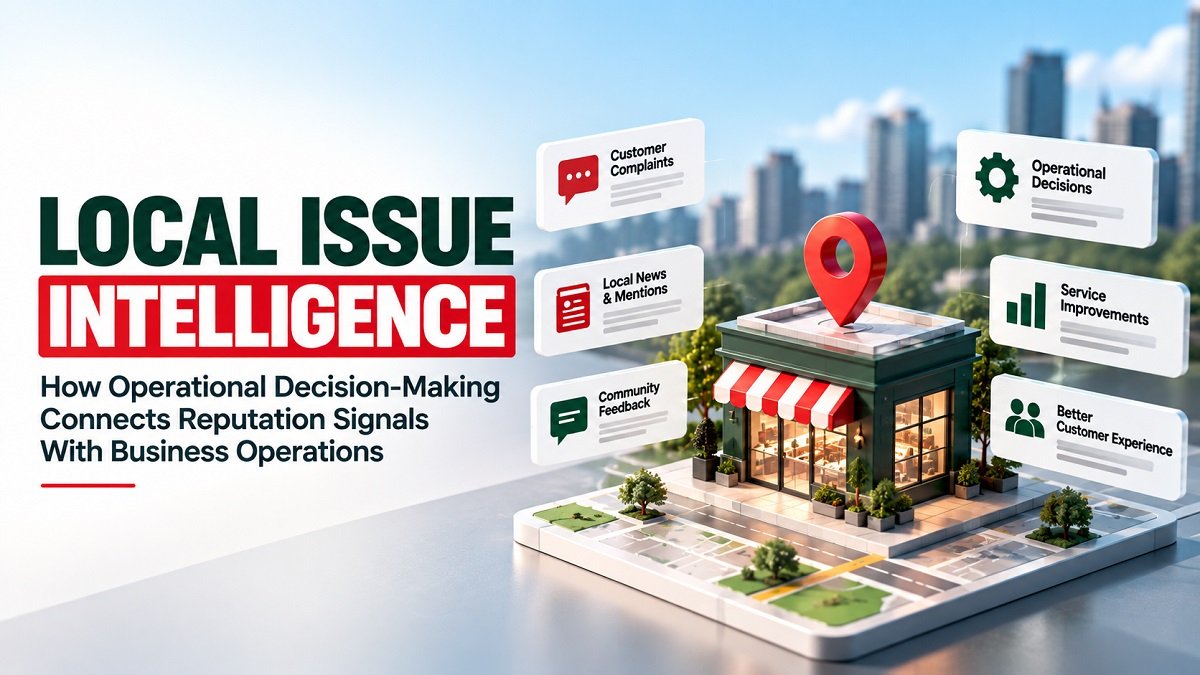
Customer experience → Customer feedback → Pattern identification → Operational improvement → Better customer experience
That loop is much more sustainable than simply responding to negative reviews.
A business cannot permanently improve its reputation by managing the appearance of problems while leaving the underlying experience unchanged.
Reputation becomes stronger when operational improvements produce better customer experiences naturally.
For businesses that need a more structured approach to monitoring and managing these reputation signals, a dedicated Reputation Manager can become part of the broader process.
The important point is that reputation tools should support business understanding, not replace it.
Connect Feedback With Business Data
Customer feedback becomes even more useful when it is compared with internal business data.
For example, a company could compare feedback themes with:
-
Response times
-
Appointment delays
-
Refund requests
-
Customer retention
-
Repeat purchases
-
Support tickets
-
Conversion rates
-
Cancellation rates
-
Service categories
-
Location-level performance
This creates a stronger analytical picture.
Imagine customers frequently mention delayed responses.
If internal records also show that leads contacted after business hours receive responses much later, the business has identified a measurable process gap.
The feedback did not merely reveal dissatisfaction.
It helped identify where the operation needs attention.
That is the transition from reputation monitoring to business intelligence.
Use Location and Service Patterns to Find Hidden Weaknesses
For businesses that depend on local customers, these feedback patterns can also influence how the company is understood in local search. Consistent information, customer experiences, service relevance, and location-specific signals all contribute to the broader digital presence. This is why local SEO strategy should consider more than rankings alone. It should support a business presence that accurately reflects what customers experience and what the company actually provides.
Operational problems are not always company-wide.
They may appear in one location, one service category, one team, or one customer segment.
A multi-location business might have strong feedback overall while one branch receives repeated complaints about communication.
A service company may have excellent reviews for installation but weaker feedback for maintenance.
A restaurant may receive strong comments about food quality but repeated complaints about pickup timing.
Without segmentation, these patterns can disappear inside the overall rating.
Advanced Customer Feedback Analysis should therefore ask:
Where is the problem happening?
Then:
When is it happening?
And finally:
Which part of the customer journey is affected?
These questions can uncover operational weaknesses that a company-wide reputation score cannot explain.
Build a Feedback-to-Action Workflow
Businesses do not need a complicated system to start using feedback as intelligence.
A practical workflow can follow five stages.
1. Collect
Bring together relevant customer feedback from reviews, surveys, support conversations, social channels, and other available sources.
2. Categorize
Group feedback into meaningful operational themes rather than only positive and negative sentiment.
3. Detect Patterns
Look for repetition across customers, time periods, services, locations, and channels.
4. Investigate
Compare recurring complaints with internal processes and business data to identify possible root causes.
5. Act and Measure
Make an operational change and monitor whether the same complaint becomes less common afterward.
This final stage is critical.
If the business identifies a problem but never measures whether the change worked, the feedback process remains incomplete.
The Goal Is Not Fewer Negative Reviews
This distinction matters.
A business that focuses only on reducing negative reviews may accidentally optimize for appearance instead of customer experience.
For example, employees might become focused on asking satisfied customers for more reviews while the underlying scheduling problem remains unresolved.
The review score could improve temporarily.
The operational weakness would still exist.
A better objective is to reduce the causes of repeated customer frustration.
If response times improve, customers should experience better communication.
If pricing becomes clearer, expectation-related complaints should decline.
If scheduling improves, delay-related feedback should become less frequent.
The reputation improvement should become a consequence of better operations.
From Reputation Data to Management Decisions
The future of reputation management is increasingly connected to organizational learning.
Customer feedback can tell a business what customers notice, where expectations are being missed, and which parts of the experience repeatedly create friction.
When that information is connected with internal data, it becomes much more valuable.
A reputation problem may actually be a process problem.
A review problem may actually be a communication problem.
A customer-service problem may actually be a staffing problem.
A recurring complaint may actually be a workflow problem.
This is why advanced Customer Feedback Analysis should be treated as a management input rather than simply a marketing activity.
Businesses that understand this distinction can use customer feedback to improve more than their online image.
They can improve the business itself.
A Stronger Reputation Starts With Better Operations
Reputation is often discussed as something a company needs to protect.
But a strong reputation is also something a company continually produces through its operations.
Customers experience the business.
They form an opinion.
They describe that experience publicly or privately.
Those descriptions create patterns.
Those patterns can reveal operational weaknesses.
And those weaknesses can become opportunities for improvement.
That creates a much more useful way to think about reputation:
Reputation is not only an outcome to monitor. It is a source of business intelligence.
For companies managing reputation across multiple channels, locations, or customer touchpoints, the next step is to connect reputation insights with a broader management process rather than treating each review as an isolated event.
When customer feedback is analyzed this way, the business stops asking only, “Are customers happy?”
It starts asking better questions:
Where are customers experiencing friction?
Why is that friction happening repeatedly?
Which operational process is creating it?
What should change?
And most importantly:
Did the change improve the customer experience?
That is the real move from reputation monitoring to business intelligence.
The value of customer feedback is not simply in counting what customers say.
The value is in understanding what their experiences reveal about the business—and using those insights to build a stronger operation, a better customer experience, and a more credible reputation over time.